Rooms and Tunnels
Two ways to get something off your computer and to someone else, without uploading it somewhere first and without opening up your machine.
There’s a file on your laptop that someone else needs. Or a service running on a port only you can see, and a colleague who wants a look at it.
The usual answers are both a bit grim. Upload it somewhere first and send a link to the copy, which means waiting twice and leaving the file sitting on a third party’s disk. Or open a hole in your own network and hope you remember to close it again.
BEAM does neither. It offers two ways to hand something over. A tunnel gives one thing on your machine a web link. A room is a private group of machines that send files to one another. One is for reaching outward; the other is for working together.
They are built on the same foundation, so start there.
The part that’s the same
Whichever you use, your computer reaches out to BEAM and holds that connection open. Nothing ever connects back in to you — no port to open, no firewall to change, no address to hand out. Your machine stays as invisible to the outside world as it was before you started.
That single fact is what lets a machine take part from anywhere it happens to be, including somewhere nothing can reach it. Everything below is built on it. A tunnel and a room differ only in who ends up on the other end.
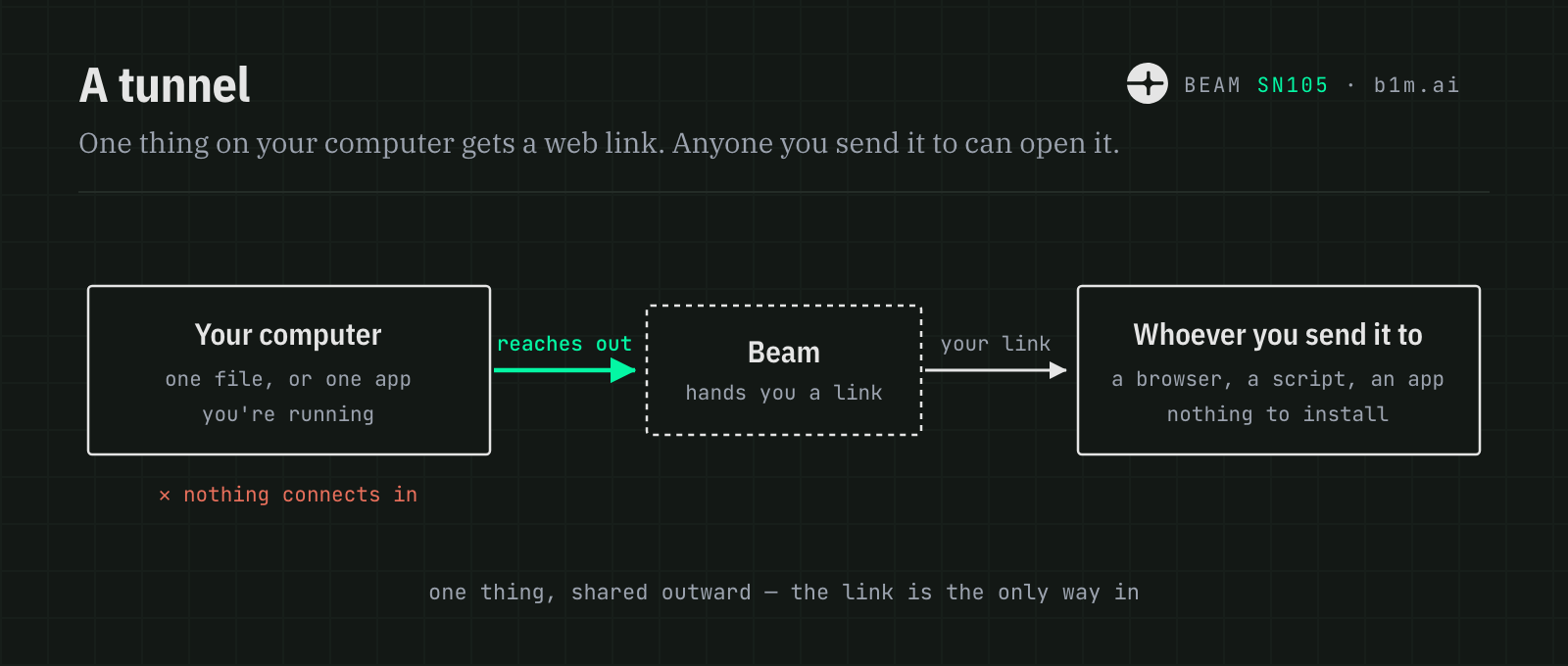
A tunnel
Pick a file, or an app you have running. BEAM gives you a link to it. It’s an ordinary web link, so whatever is on the other end can just fetch it — a person in a browser, a script, or another service entirely. No account, and nothing to install.
Handy for sending someone a file too large to email, showing a colleague the site you’re building before it’s deployed, or letting another service pull data straight off your machine.
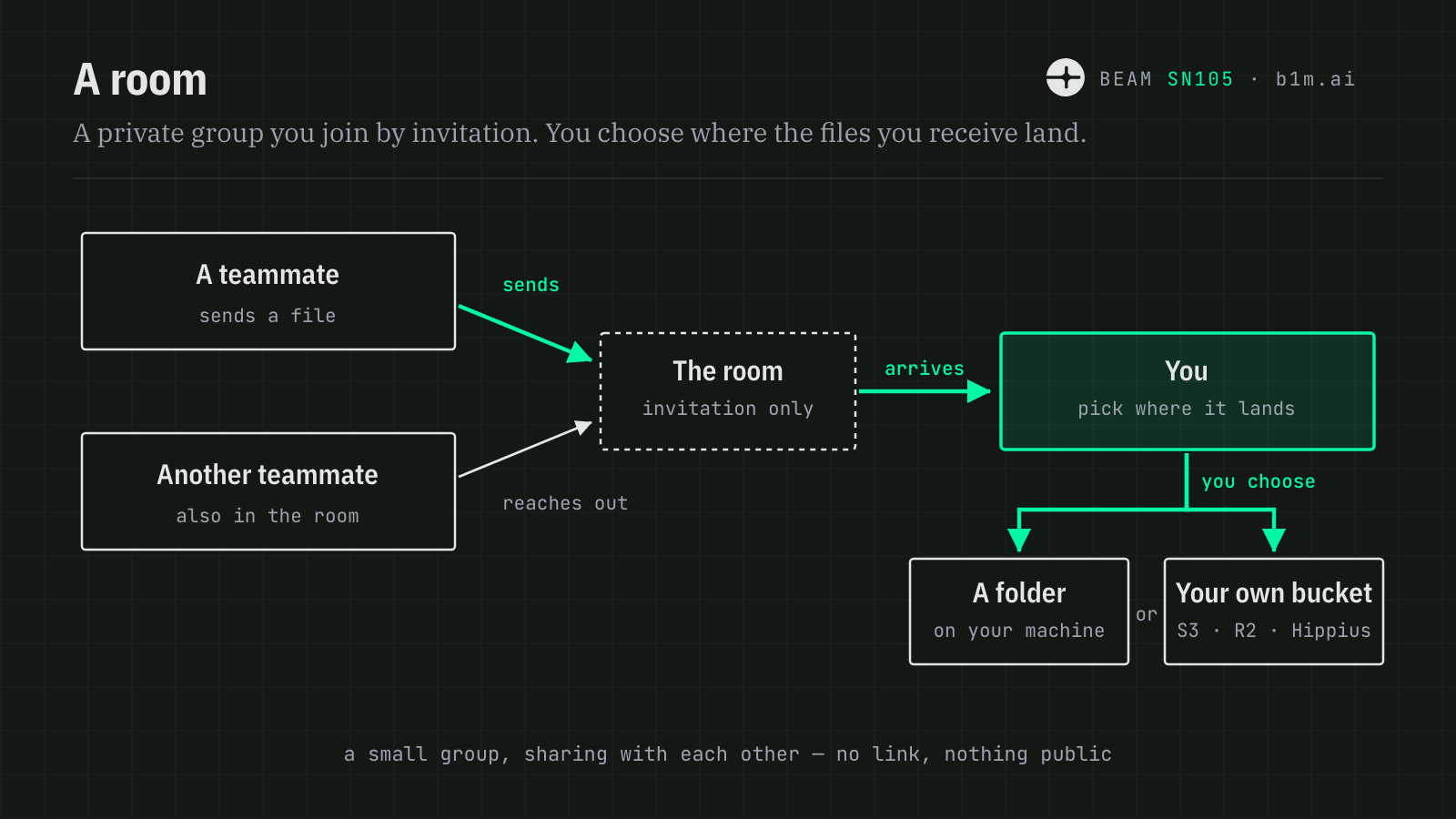
A room
Someone creates a room and invites you. Once you’re in, anyone in the room can send you a file and you can send files back.
You decide where what you receive ends up. A folder on your machine is the simple answer, but it can go straight into your own object storage instead — an S3 bucket, Cloudflare R2, or Hippius. Your bucket, your credentials: files arrive where you already keep things, rather than somewhere new you have to tidy up later.
Everyone at once
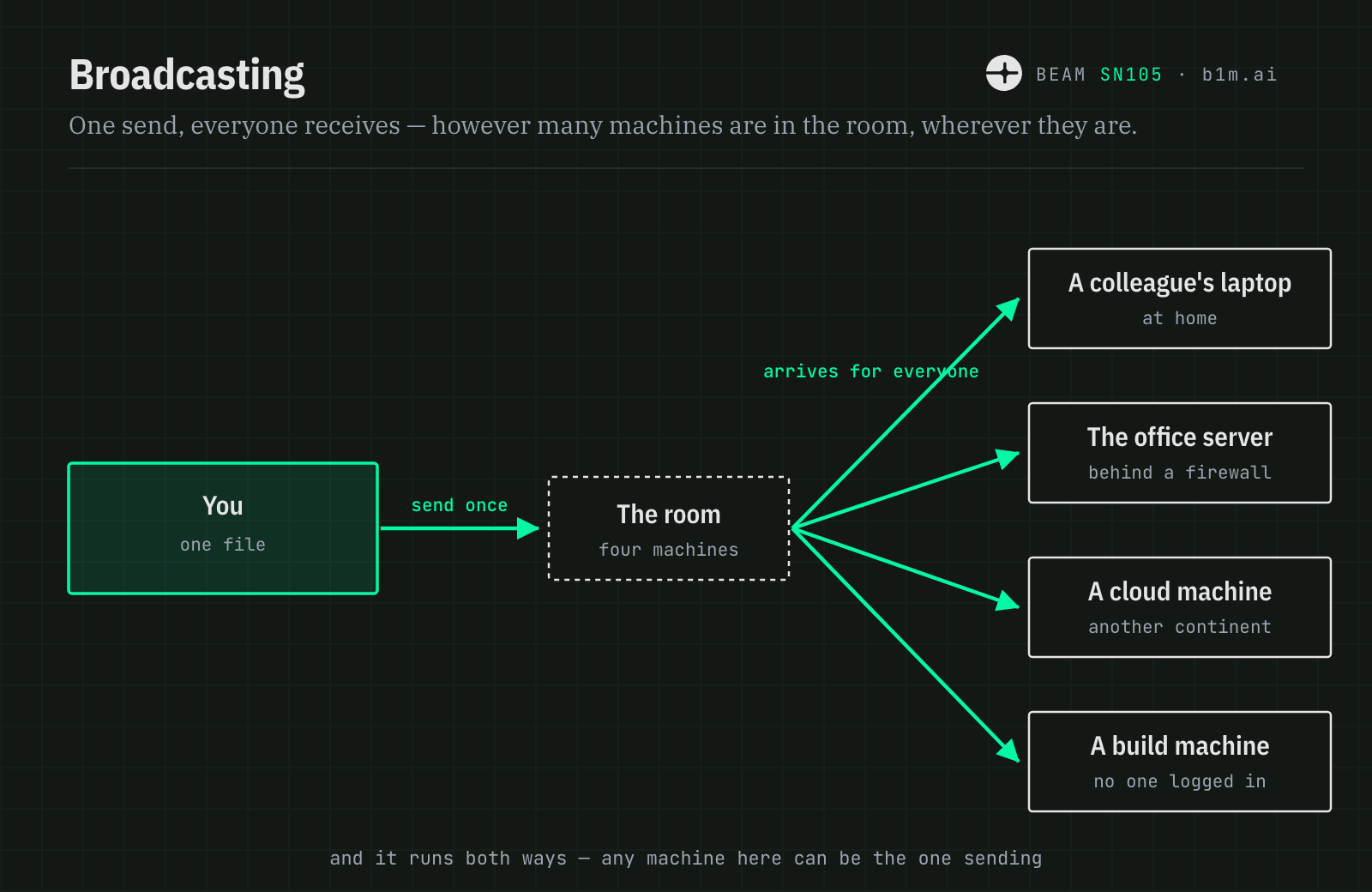
Behind the simple room model is an any-to-any broadcast network. Any member can become the sender, and any combination of members can become the receivers.
So a room isn’t one person publishing to an audience. Send once and it arrives for everyone — whether that’s two machines or twenty, sitting in an office, a data centre, or someone’s kitchen.
You can also aim it. Send to the whole room, or pick out just the one or two machines that need it.
Which one do I want?
| Tunnel | Room | |
|---|---|---|
| Who can get in | Anyone holding the link | Only the people invited |
| What they need | A browser, a script, or any HTTP client | BEAM CLI or Studio, plus an invitation |
| Which way it flows | You share one thing outward | Everyone shares with everyone |
| How long it lasts | Until you close it | Until you leave the room |
| Best for | Getting one thing to one person, once | A group that keeps trading work |
Why this is a bigger deal than it looks
On its own, “send someone a file” sounds unremarkable. What’s unusual is everything you no longer need in order to do it.
None of these is remarkable on its own. Having all of them at once, while your machine sits there with nothing listening on it, is.